
If you have spent any time in a Spiritist center, you have heard someone say "that's in Nos Domínios da Mediunidade" or "look at what André Luiz tells us in Ação e Reação." These books have become a common language among us. Even so, it is rare to meet someone who has read the whole series in sequence, slowly, pencil in hand. Most people began wherever life put a copy in their hands: a loan, a study group, the film that stirred their curiosity.
This text is meant to put that in order. We will go through the thirteen books of the collection A Vida no Mundo Espiritual (Life in the Spiritual World) in the order they appeared, say what each one is about, and suggest how to read without getting lost. At the end, we talk about why people who study André Luiz often come back from Minas Gerais reading these pages differently.
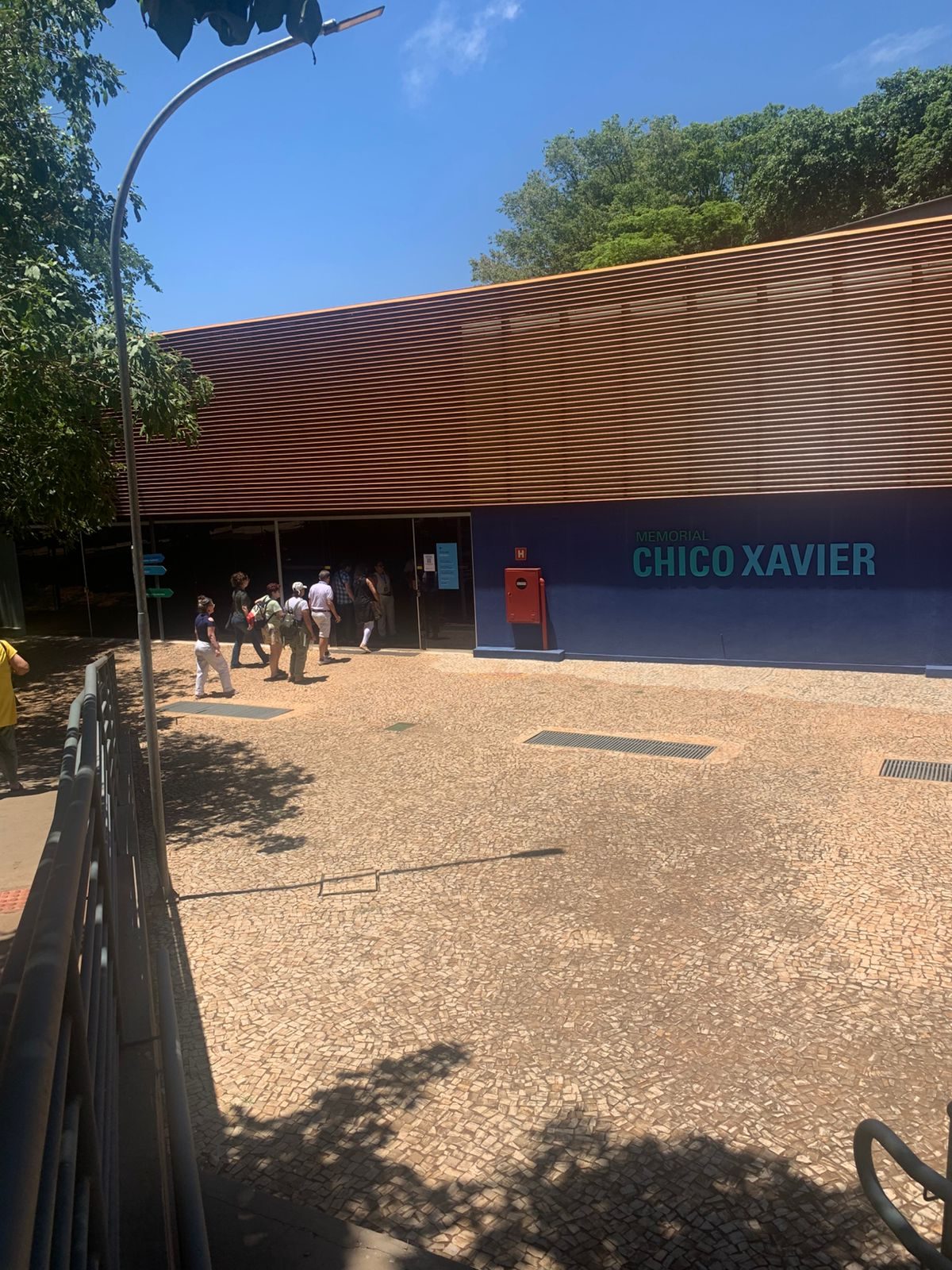
Entrance of the Chico Xavier Memorial in Uberaba. Mundo a Passeio travel archive.
Who André Luiz is and how the collection is organized
The FEB (Brazilian Spiritist Federation) presents André Luiz as a spirit who calls himself an apprentice and whose real name has never been revealed. In life, according to the publisher, he was a public-health physician in Rio de Janeiro in the early twentieth century. He writes like a humble reporter: he tells what he saw, what he got wrong and what was explained to him, and rarely speaks as someone who already knows everything.
The collection FEB groups under A Vida no Mundo Espiritual has thirteen volumes. The publisher's catalogue lists seventeen André Luiz titles in all, so some books sit outside this core; we come back to one of them below. Ten of the thirteen were psychographed by Chico Xavier. Three of them (Evolução em Dois Mundos, Mecanismos da Mediunidade and Sexo e Destino) also carry Waldo Vieira's name as medium, according to FEB's listings.
A word on dates, to be straightforward: FEB Editora states the year of psychography only for Nosso Lar, 1944. For the others we rely on the most cited bibliographic lists, and they differ by a year here and there. Where sources disagree we say "late 1940s" or "late 1950s" instead of fixing a number.
The first four: arriving, working, being reborn, passing
Nosso Lar (1944) opens everything. The physician André Luiz wakes in a dark, anguished region, is rescued and taken to the colony that gives the book its name, an organized spiritual city with work, study and hierarchy of service. The core idea is that life continues and that the suffering at the start is tied to how one lived. Many readers stumble because they read it as a description of a place and forget that the centre of the book is the narrator's transformation. (Portuguese title kept; editions in other languages circulate under different titles.)
Os Mensageiros (1944; published in English as The Messengers) has 51 chapters and shifts the focus from the newcomer to the apprentice at work. André Luiz follows spirits who reincarnated with defined tasks and, in many cases, fell short of what they had agreed to do. As FEB summarizes it, work renews the mind. It is a good book for groups, because each case raises a practical question: what did I commit to and am I not fulfilling?
Missionários da Luz (1945, "Missionaries of the Light"), with 20 chapters, deals with reincarnation and with the work of those who accompany rebirth. The perispirit appears as the mould of the body's cells, and mediumship as the link between two planes. It tends to open the mind of readers who thought of reincarnation only as an abstract concept.
Obreiros da Vida Eterna (1946; English edition Workers of the Life Eternal), also with 20 chapters, shows spiritual helpers assisting those who make the passage. It speaks of silent compassion and of service without applause. Those who visit the sick or support grieving families read it differently.
Mid-series: the mind, rescue, forgiveness
No Mundo Maior (late 1940s, "In the Greater World") is the book of the mind. André Luiz examines causes of mental imbalance and accompanies people affected by madness, combining psychiatry and Spiritist doctrine, and also treats the separation of spirit from body during sleep. Read it without rushing to diagnose anyone: the text belongs to its time and does not replace medical care.
Libertação (1949, "Liberation") places the reader in a rescue mission. Gregório, a disturbed spirit, leads a group of obsessors acting on Margarida, a woman he knew in earthly life. We follow a plan of help led by higher spirits. FEB's summary puts it well: forgiveness, study and work open the way to liberation. For anyone who serves in a mediumistic meeting, it is nearly required reading.
Entre a Terra e o Céu (1954, "Between Heaven and Earth") is the closest to a novel. Zulmira, Amaro and Odila share bonds, jealousy and hardship across two worlds and several incarnations. The centre is coexistence: what an old grievance does in today's household, and how forgiveness unties knots that seem eternal.
Mediumship and the law of cause and effect
Nos Domínios da Mediunidade (1955; English edition In the Realms of Mediumship; Spanish En los dominios de la mediumnidad) appears in more mediumship courses than any other. André Luiz and his friend Hilário leave the colony for the earth's surface and observe, in homes and meetings, how communications really happen. FEB notes that the book affirms mediumship as a faculty spread through all humanity, running from clairvoyance and clairaudience to physical effects. It is essential reading for serious study, and it converses directly with Kardec's The Mediums' Book.
Ação e Reação (1957; Spanish edition Acción y reacción) takes André Luiz and Hilário, for three years, to Mansão Paz, an institution tied to the Nosso Lar colony that helps suffering spirits from regions near Earth. The cases show the law of cause and effect in detail: the past shapes the present, and what we do today shapes what comes. There are also pages on the lower regions, the suffering of a guilty conscience and the strength of prayer.
The "scientific" volumes and the mature novel
Evolução em Dois Mundos (late 1950s; English edition Evolution in Two Worlds) is the densest. In two parts, it connects Christ's teachings to themes such as the perispirit, cosmic fluid, heredity and the evolution of the mind, then answers questions about marriage, divorce, pregnancy and abortion. It is not a starting point. It is for those who like to study with a pen.
Mecanismos da Mediunidade (1960, "Mechanisms of Mediumship") links scientific ideas to Spiritism: energy, the atom, obsession, hypnosis, magnetism, animism, psychometry. The underlying message is that mediumship with Jesus demands discipline, study and responsibility.
Sexo e Destino (1963; English edition Sex and Destiny) mixes study and narrative. In mid-twentieth-century Rio de Janeiro, two families, the Torres and the Nogueiras, live love, jealousy and hatred, and André Luiz reflects on freedom, guilt and reincarnation, explaining how affective conduct can echo in future lives. One presentation of the collection assigns the first part to Waldo Vieira and the second to Chico Xavier.
E a Vida Continua... (1968; English edition And Life Goes On...) closes the collection with real characters who receive help from spiritual friends when they pass over. It is a coherent ending: the series begins with a newcomer and ends by showing that life goes on for everyone.
Outside the thirteen, FEB also publishes Desobsessão (Disobsession), whose listing names Waldo Vieira as author and André Luiz as spiritual author. It is a 73-chapter guide for those who run disobsession meetings in a Spiritist center, from preparing the meeting to follow-up afterwards. It is not a first read, but it is a treasure for a center's team.
Where to start
Publication order works well for first-time readers, because André Luiz himself learns as the books go on. Starting with Nosso Lar makes sense in most cases, and the sequence Os Mensageiros, Missionários da Luz and Obreiros da Vida Eterna prepares the ground for the rest.
If your group already practises mediumistic meetings, an alternative is to open with Libertação and Nos Domínios da Mediunidade, which speak directly to what you do on Thursday night. And if the group is new, leave Evolução em Dois Mundos and Mecanismos da Mediunidade for the second year of study.
Reading in a group without turning it into a primer
A routine that tends to work is one chapter per meeting, read beforehand at home, with three questions on the table. What does the chapter claim? How does it relate to Kardec? And what changes in my practice this week? Without the third question, study becomes pleasant conversation and little else.
Two cautions are worth their weight in gold. First, treat André Luiz as a work to be studied in the light of Kardec, not as a replacement: whatever is new is checked against The Spirits' Book and The Mediums' Book. Second, do not turn descriptions of the spiritual world into a literal map; the firmest thing in the books is the moral teaching. Group study also calls for patience with slow readers and respect for those with doubts, because a well-handled doubt yields more than automatic agreement.
What changes when you read and then visit
Many people who studied Nos Domínios da Mediunidade and Ação e Reação say that visiting the places of Chico Xavier and Eurípedes Barsanulfo felt like a rereading. The Casa de Memórias and the Memorial in Uberaba have the quiet of places that belonged to working people, and many visitors speak of an atmosphere of serenity and of a good energy there. That is a perception; for Spiritists it fits what the books say about environment and prayer. None of this is a promise or a measurement: it is what some visitors report.
To plan your visit, read our texts on Chico Xavier in Uberaba, Pedro Leopoldo and how to behave in a Spiritist center. The caravan we run from Porto Alegre and region is on Saindo de Porto Alegre: caravana espírita (Portuguese), and the Minas itinerary is on Minas Espírita (Portuguese).
If you want to talk about your next group, message us on WhatsApp. Current dates and prices are always on the trip pages.
Sources
Consulted on 30/10/2026: FEB Editora, André Luiz page and the listing for each title at febeditora.com.br. Publication years other than Nosso Lar follow bibliographic lists that differ among themselves; Wikipedia was used only as a lead, not as proof. Summaries are ours, based on the publisher's synopses.