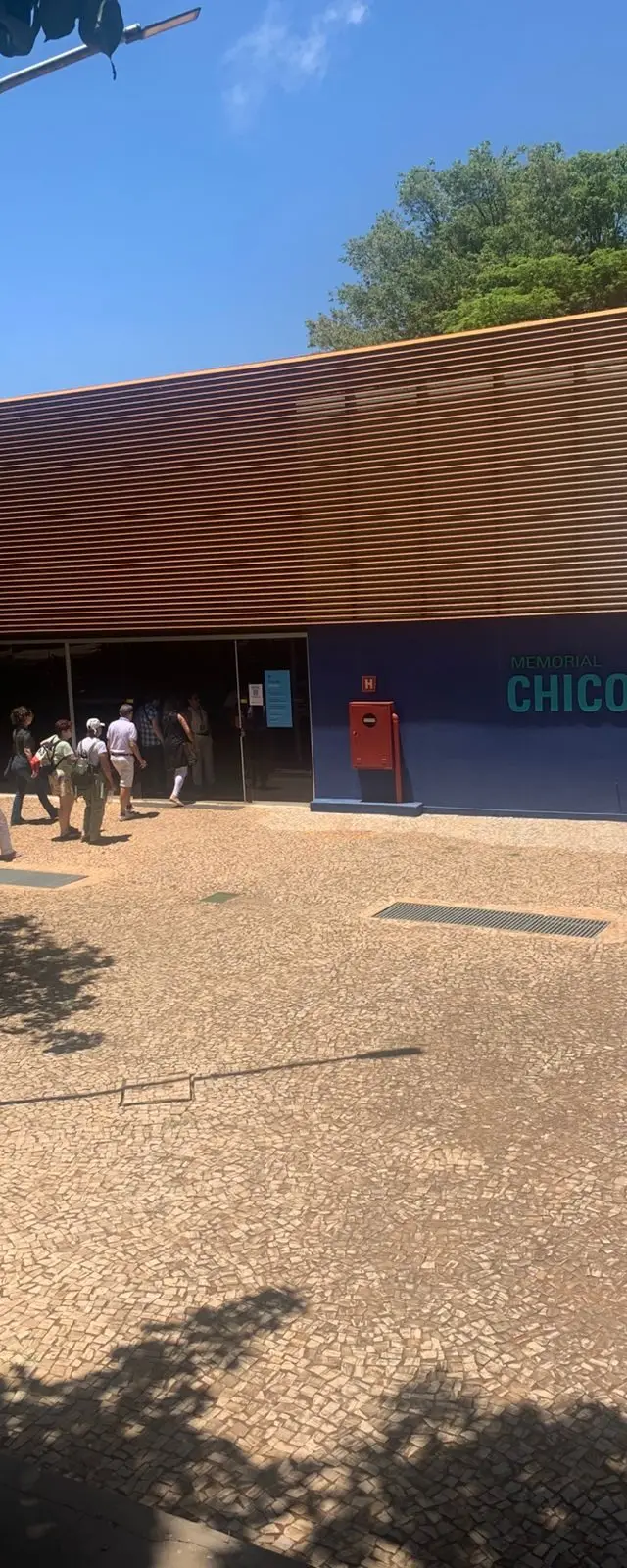
Whoever packs for a Spiritist trip usually sets aside a book or two. The question we hear most is which ones. Our answer is that it depends on where you will be standing. A book read a week before walking into a museum or a study room changes what your eyes pick up there.
André Luiz alone would fill a library, and we dedicated a separate text to him, on the series in publication order. Here we turn to the rest of the shelf: a book of poems, two Emmanuel novels, and readings on the lives of Chico Xavier and Eurípedes Barsanulfo. For each, we say what it adds to each stop on the route.
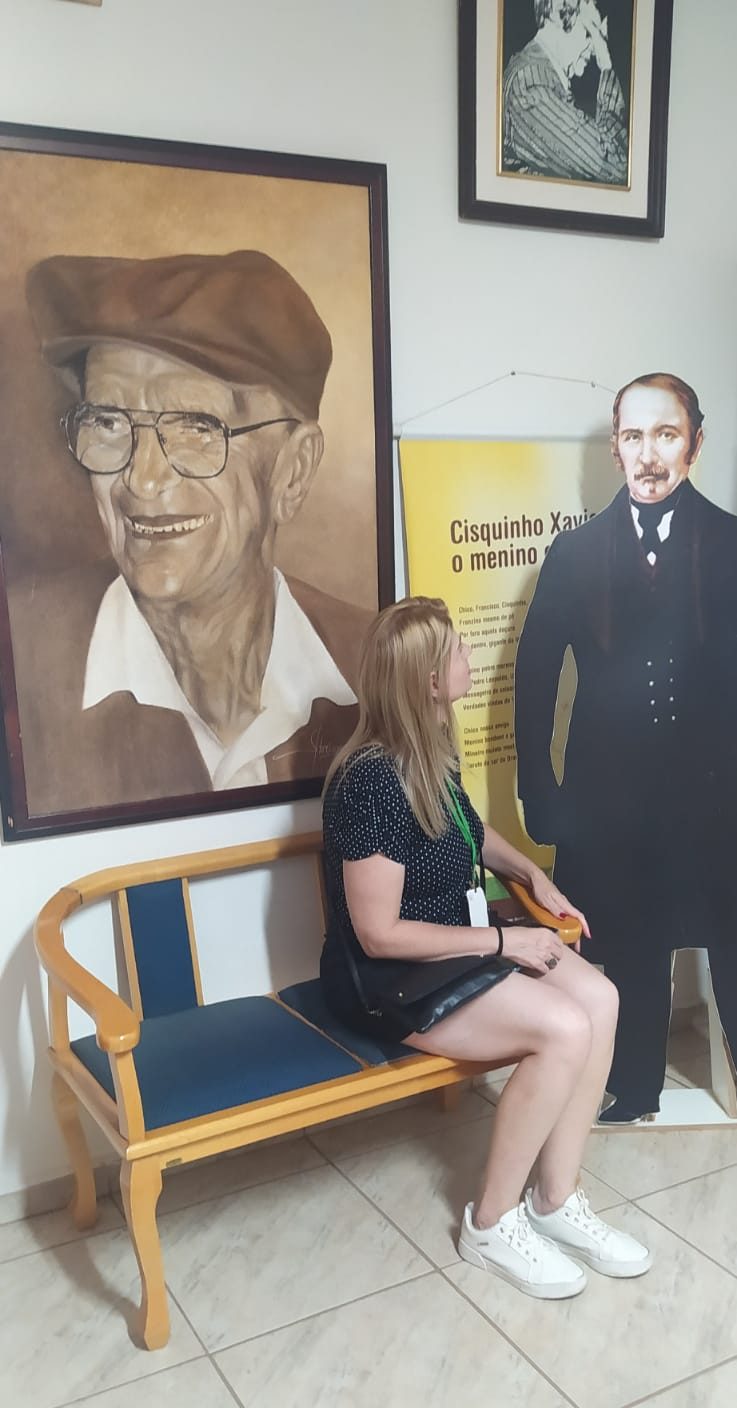
In front of the portrait of Chico Xavier, April 2024 caravan to Minas Gerais. Mundo a Passeio travel archive.
Parnaso de Além-Túmulo: where it all begins
FEB presents Parnaso de Além-Túmulo ("Parnassus from Beyond the Tomb") as the first work psychographed by Chico Xavier, the start of the mediumship that would accompany him all his life. It holds more than two hundred poems attributed to 56 Brazilian and Portuguese poets, with verses of comfort and hope about the survival of the soul. The date usually cited is 1932.
Why read it before going? Because it shows the beginning of Chico's mediumship, before the phase of the great Emmanuel and André Luiz novels. Many people who have read Emmanuel and André Luiz never opened the Parnaso, and that is a gap. When you stand in Pedro Leopoldo before the statue in the square, the book gives an emotional timeline, because that is where Chico's public story begins to be told. See also what we wrote about Pedro Leopoldo, land of Chico Xavier.
A reading suggestion: do not read the Parnaso cover to cover. Choose ten or twelve poems, read them aloud, and note what each says about life after death. The style belongs to its time and tires when taken in one go.
Emmanuel: Há Dois Mil Anos and Paulo e Estêvão
Emmanuel is the spirit who, according to FEB, signs a large share of Chico's works. Two of his historical novels help anyone going to Minas, not for their setting, Palestine and Rome, but for their theme: nascent Christianity and conversion as a process.
Há Dois Mil Anos (late 1930s; "Two Thousand Years Ago") tells, in FEB's description, the life of Publius Lentulus, a Roman senator appointed to a high post in Palestine in the time when Jesus taught. His household lives extremes of suffering and joy, power and servitude, and his wife, Livia, converts to Jesus's teaching against her husband's wishes. For the traveler, the book offers a lesson about pride and conversion that fits Sacramento well: there, the story of Eurípedes Barsanulfo is that of a man who joined Spiritist faith, school and free care, and the novel helps think about what it means to hold a conviction in front of those who disagree.
Paulo e Estêvão (early 1940s; "Paul and Stephen"), 512 pages in FEB's current edition, follows Paul of Tarsus, the former Pharisee persecutor who converts, his link with Stephen, the first martyr, and his love for Abigail. The publisher highlights the central message: love covers many faults committed across lifetimes. For the traveler the book asks for patience, because it is long, and it yields questions for road conversations: what does it mean to serve when prestige is lost? And who in our own story was Stephen to us?
If your time is short, start with Há Dois Mil Anos, whose family plot and Livia's conversion are easy to follow. If time is no problem, Paulo e Estêvão, with its 512 pages, is good company for the hours on the road.
Biographies of Chico Xavier
For Chico's life there are readings with different purposes. As Vidas de Chico Xavier, by Marcel Souto Maior, is a journalistic biography, published in an updated edition by Planeta in 2003. It is the most widely read entry point for an overview. It has the tone of a report, and it is worth reading knowing that: it is a biographical eye, not a substitute for doctrinal study.
On the Spiritist publishing side, FEB has Depoimentos sobre Chico Xavier, a collection of testimonies from relatives and longtime Spiritist workers in Pedro Leopoldo and Uberaba, and Trinta anos com Chico Xavier, by Clovis Tavares, the memoir of someone who knew him from 1936 to 1966. These are books of affection. They do not claim a biographer's distance, and that is exactly what makes them valuable before visiting the Casa de Memórias and the Memorial.
How each adds to the route: Souto Maior helps place dates and context; the testimony books give the close-up view that makes the visit to the Uberaba house more personal. Our guide to Chico Xavier in Uberaba covers the practical side.
Eurípedes Barsanulfo
Here the bibliography is leaner, and it is worth knowing the name of Corina Novelino. Her Eurípedes, o Homem e a Missão is listed in bibliographic references as a biography written on the eve of the centenary of Eurípedes's birth, in 1979, and is cited as the basis of other biographies. There is also an academic study from UFU on Spiritism and education in Eurípedes's work, good for those who like to see the figure in historical context, and books by other authors, such as Jorge Rizzini, among the references listed.
If you only have time for one reading, prefer a short, reliable biography before the trip, and leave the others for afterwards, when the images of the Colégio Allan Kardec are already in your memory. See what we have already written in who was Eurípedes Barsanulfo and the history of the Colégio Allan Kardec.
How to read without turning reading into a chore
One tip for any of these books: before opening, write in two lines what you expect to find. When you finish, go back to the note. The gap between what you expected and what you found is the most interesting part of study, and it tends to make for good conversation when the group meets.
Another: read at least one passage aloud to someone in your family or group. Emmanuel's novels use the language of their time and, for many people, work better read aloud. And if the group is traveling together, agree beforehand who reads what. Splitting the readings lets each person tell the others, at stops and on bus stretches, what they discovered, and the trip becomes richer than if everyone had read the same thing.
Kardec is still the anchor
None of the readings above replaces Allan Kardec. If you will visit centers, meetings and places of study, the chapter of The Mediums' Book that speaks to what you saw will be your compass. For a refresher, our article on mediumship according to The Mediums' Book helps, and the one on how to behave in a Spiritist center avoids blunders.
A realistic reading plan
A simple proposal, for those with four to six weeks: a week of Parnaso de Além-Túmulo in small doses; two weeks of Há Dois Mil Anos or Paulo e Estêvão; a week for a biography of Chico; one for whatever exists on Eurípedes. If time remains, an André Luiz that matches your practice. If time runs short, choose one reading and do it well.
Another good idea is to carry a notebook and write down, at each stop, a sentence from the book that the place brought back to mind. On return, those sentences become a study.
Being in the places with the reading in your head
Those who read beforehand often say the place speaks differently. The silence of a room, the calm of a house, the sense of serenity so many visitors mention, which many Spiritists understand as the energy of an environment shaped by prayer and work, make more sense when you have some story in your head. All of this is perception, and you may feel something else.
To see the itinerary, visit Minas Espírita and Saindo de Porto Alegre: caravana espírita (Portuguese pages). If you want to talk about the next departure, message us on WhatsApp.
Sources
Consulted on 30/10/2026: FEB Editora listings for Parnaso de Além-Túmulo, Há Dois Mil Anos, Paulo e Estêvão, Depoimentos sobre Chico Xavier and Trinta anos com Chico Xavier; Jornal de Brasília on As Vidas de Chico Xavier; UFU repository. Publication years are those of the usual bibliographic lists; FEB does not give them on its listings.